 The Chemistry of Baking and Respect for Professionals
Global Series Vol. 5:Ashikita Craftsmanship
[JP]
芦北高校農業科の活動を世界へ届けるシリーズ。
私たちが大切にしている活動の記録を厳選し、月に一度、英語版としてお届けします。
第5回は、5月20日の「2年生・食品製造実習(シュー・ア・ラ・クレーム)」の記録です。
[Global Series Vol. 4:Weeds, Buds, and a Farmer’s Dilemma はこちら]
[EN]
Sharing the passion of Ashikita Agricultural High School with the world. Once a month, we present an English edition of our specially selected stories. Vol. 5: Sophomore Food Processing Practice — Choux à la Crème (May 20th).
[Click here for Global Series Vol. 4:Weeds, Buds, and a Farmer’s Dilemma]
— Sophomore Food Processing Practice: Science and Senses in Pastry Making —
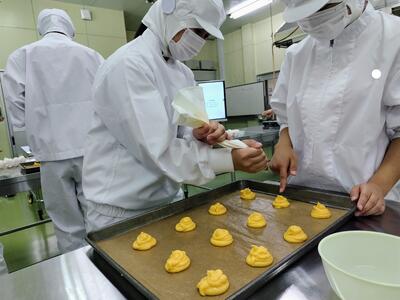
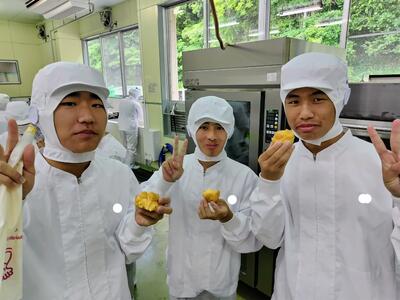
Today, the food processing lab for our second-year Agricultural Department students was filled with a sharper sense of tension than usual, alongside a sweet, aromatic fragrance. The challenge was making "Choux à la Crème" (cream puffs)—a classic pastry that requires advanced technique and intense concentration.
■ Observation with the Five Senses, Not Just Mixing
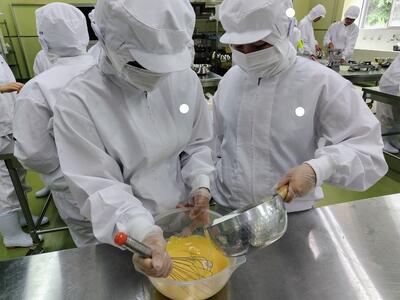
Whether making the custard cream filling or the choux pastry base, the most crucial point in both processes is that it is "not just mechanical mixing."
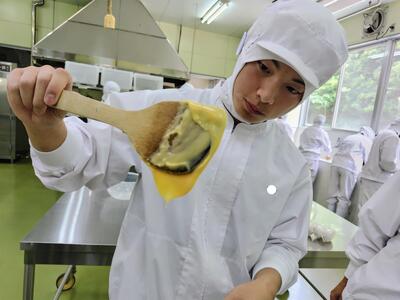
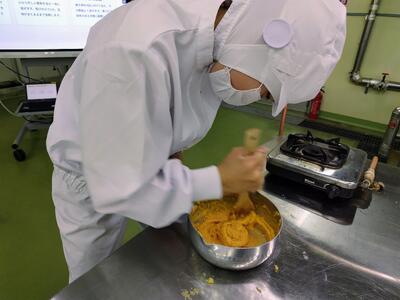
To prevent scorching and lumps while achieving a smooth texture, the students constantly focused on the feel at the bottom of their pots and bowls, carefully observing whether the overall color change was uniform.
Their eyes, as they lifted wooden spatulas to check the consistency, were those of true professional artisans.
■ The Challenge of Gelatinization
The Golden Rule for Rising. Furthermore, choux pastry comes with a strict, minimum requirement: the dough must rise beautifully and significantly. By bringing butter to a complete boil in a pot, adding flour all at once, and mixing rapidly, the heat triggers the starch molecules to bind—a process known as "gelatinization" (koka).
This is where the lab earned its name, "Food Processing." From the precise measurement of ingredients to the exact second the pot is removed from the heat, the optimal ratio for adding eggs while judging the dough's temperature, and the tactile sensation of thickness felt through the spatula to their fingertips—everything relies on logical conditions. If even one measurement or sensation is off, the pastry will never rise in the oven. Food processing is a highly delicate world of "chemistry" controlled by the five senses and scientific knowledge.
■ Beautiful Results and the Physics of Baking
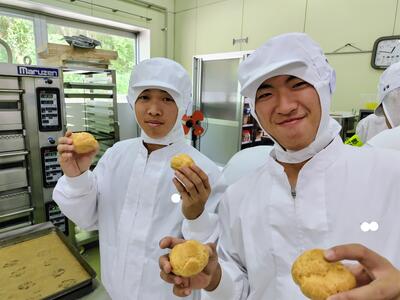
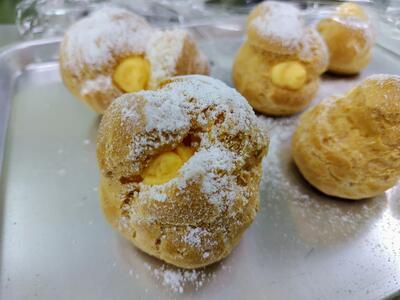
For most groups, the pastry puffed up into a beautiful golden brown through the oven glass, resulting in wonderful choux shells.
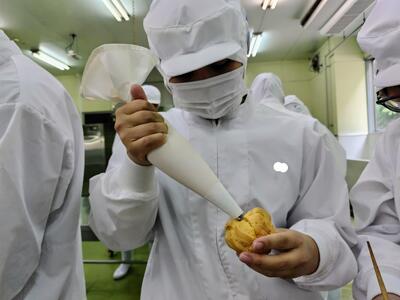
Amid cheers of success, they piped in plenty of smooth custard, completing beautiful "Choux à la Crème" one after another.
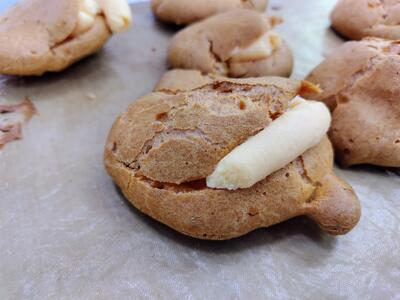
However, out of the ten groups in the practical lesson, there was one group whose pastry just wouldn't rise properly.
The cause traced back to a slight variance in heat control during the dough-making process. While those around them succeeded, they fell short of the ideal shape, leaving a lingering sense of frustration. Yet, when it came time to taste—"It actually tastes delicious!"—smiles broke out at the quality of the flavor.
Following the lesson, students shared that their perspective on the cream puffs they casually see in convenience stores and supermarkets had completely changed. They felt firsthand the incredible craftsmanship and corporate effort behind products that always rise beautifully and uniformly.
The students did not just gain confidence from success; they analyzed the causes of failure, turning an everyday sight into a learning experience. It was a lesson that made us look forward to the further growth of these second-year students, who use their own hands and five senses to "create" new value and insights.
〒869‐5431
熊本県葦北郡
芦北町乙千屋20-2
熊本県立芦北高等学校
管理責任者
校長 草野 貴光
運用担当者 広報部
TEL 0966-82-2034
FAX 0966-82-5606
E-mail
ashikita-h@pref.kumamoto.lg.jp
URL http://sh.higo.ed.jp/ashikita

学校からの緊急連絡(休校、授業打切り等)、各種連絡、資料・アンケート等について、学校・保護者間連絡システム「すぐーる」にて配信しております。
また、欠席・遅刻等についても本システムから連絡いただくことが可能になっております。
子どもの人権相談窓口
ふるさと納税「芦北町」
(芦北高校支援)
ふるさと納税「夢教育応援分」
 熊本県立芦北高等学校
 投稿者4
投稿者4